


Reality 1: One in five people sitting in your church this Sunday considers themselves an entrepreneur. Most pastors have no idea.
There's a number that doesn't get nearly enough attention in conversations about church health, ministry strategy, or congregational engagement. It's not an attendance figure. It's not a giving metric. It's this:
One in five people sitting in your church this Sunday morning considers themselves an entrepreneur.
Let that land for a moment.
Not one in twenty. Not one in ten. One in five. In a congregation of 200, that's 40 people. In a congregation of 500, that's 100. In a congregation of 1,000, you likely have more entrepreneurs in your pews than most churches have total attendees.
And the vast majority of them feel completely invisible.
The Gap Nobody Is Talking About
Research conducted by Barna Group found something startling: while up to 20% of churchgoers identify as entrepreneurial, 99.7% of Christ-following business owners report that they lack the community and resources they need to advance God's Kingdom through their work.
Read that again. 99.7%.
That is not a rounding error. That is not a regional anomaly. That is a systemic failure of the local church to see, serve, and deploy one of the most significant people groups already sitting in its congregation.
This isn't a pipeline problem. The entrepreneurs are already there. They showed up this weekend. They dropped their kids off in the children's ministry, grabbed a cup of coffee, found a seat, and listened to the sermon. And then they drove home feeling largely the same way they feel most Sundays — unseen in the one dimension of their life that consumes most of their waking hours.
Built for the Wrong Person
Here's the honest diagnosis: most churches are structurally designed to serve employees, not builders.
Think about your small group offerings. How are they organized? By neighborhood. By life stage. By the age of your kids. These are all reasonable organizing principles — for a workforce that clocks in and clocks out at predictable times, lives in predictable patterns, and experiences faith questions in predictable ways.
Entrepreneurs don't live that life. They carry payroll anxiety into Sunday morning. They make decisions in gray areas that no sermon series has ever addressed. They think in systems, see in opportunities, and operate in a world of risk and responsibility that most church programming simply doesn't acknowledge.
The result? They sit politely through content that was never designed for them, participate in small groups where nobody understands what they're actually carrying, and eventually — quietly — drift toward the margins of church life. Not because they stopped believing. Because nobody ever spoke their language.
->Get some help activating entrepreneurs in your church
Micro-Enterprise Changes the Math
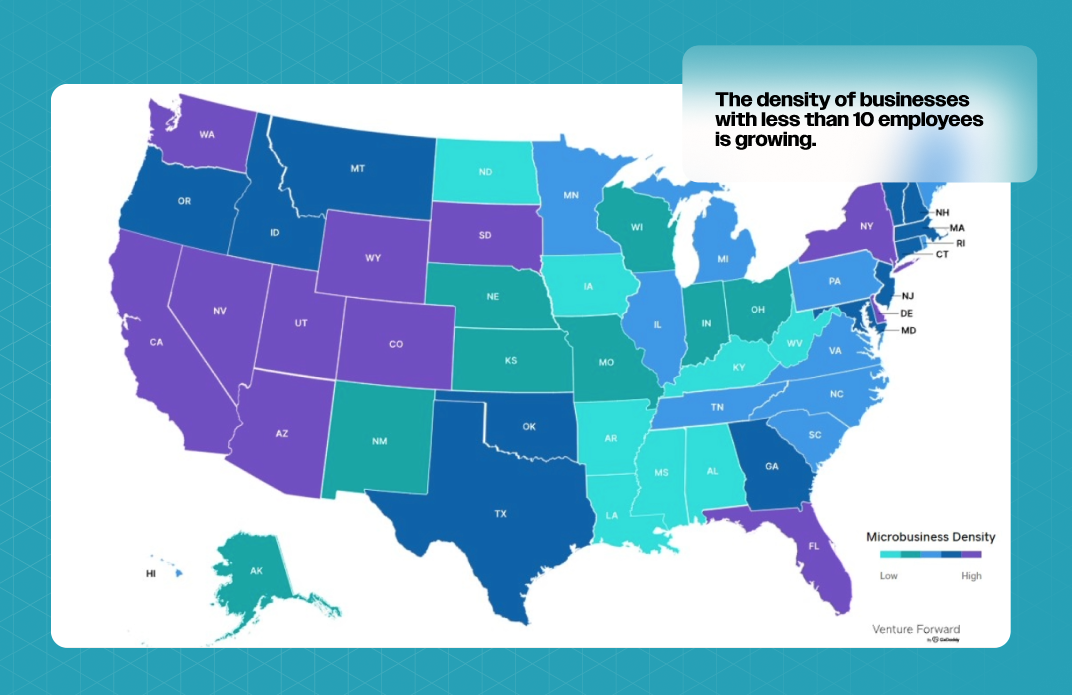
The scale of this challenge is growing, not shrinking. Globally, micro-enterprise is exploding. The number of people who identify as entrepreneurial — whether they're running a side hustle, a small business, a startup, or a freelance practice — is rising sharply across every demographic. In the United States alone, over 5 million new business applications are filed every year.
This means the entrepreneurial percentage of your congregation isn't holding steady. It's increasing. The one-in-five figure is likely already conservative for many churches, and in communities with high concentrations of young adults, technology workers, or emerging market populations, the number could be significantly higher.
The church that doesn't have a strategy for this demographic today will have a much larger problem tomorrow.
The map of micro enterprise growth across the country tells an important story that Churches cannot afford to ignore.
The Strategic Opportunity
Here's what makes this reality so important: this isn't just a pastoral care problem. It's a strategic Kingdom opportunity.
Entrepreneurs are, by nature and training, problem solvers. They see gaps and build solutions. They mobilize resources, lead teams, and create influence. When the church fails to engage them, it doesn't just lose their attendance and their giving — it loses their creativity, their networks, their leadership capacity, and their ability to extend ministry far beyond the walls of any building.
The people sitting in your pews who feel invisible on Sunday morning are the same people who, on Monday morning, are shaping workplace culture, creating jobs, making hiring decisions, and building organizations that touch hundreds or thousands of lives. That influence is either connected to the Kingdom or it isn't. That's largely determined by whether the church chose to engage them or not.
The Question You Need to Answer
Before the next section of this conversation, there's one question worth sitting with:
How many entrepreneurs are sitting in your church right now feeling completely invisible?
You probably don't know the answer. Most pastors don't. And that, in itself, is the first problem worth solving.
The entrepreneurs in your congregation aren't asking for a program. They're not asking for a conference or a curriculum. They're asking — often without words — for a pastor who knows they exist, honors their calling, and has thought about what it might mean to walk alongside them.
The scale factor is real. The people are already there. The only question is whether you'll choose to see them.
->Discover how Founder's Table can help your church reach business owners and entrepreneurs in your church and your community.
Next: The most entrepreneurial generation in history is about to become the backbone of your congregation. Are you ready for them? Read Reality 2: The Generational Factor.